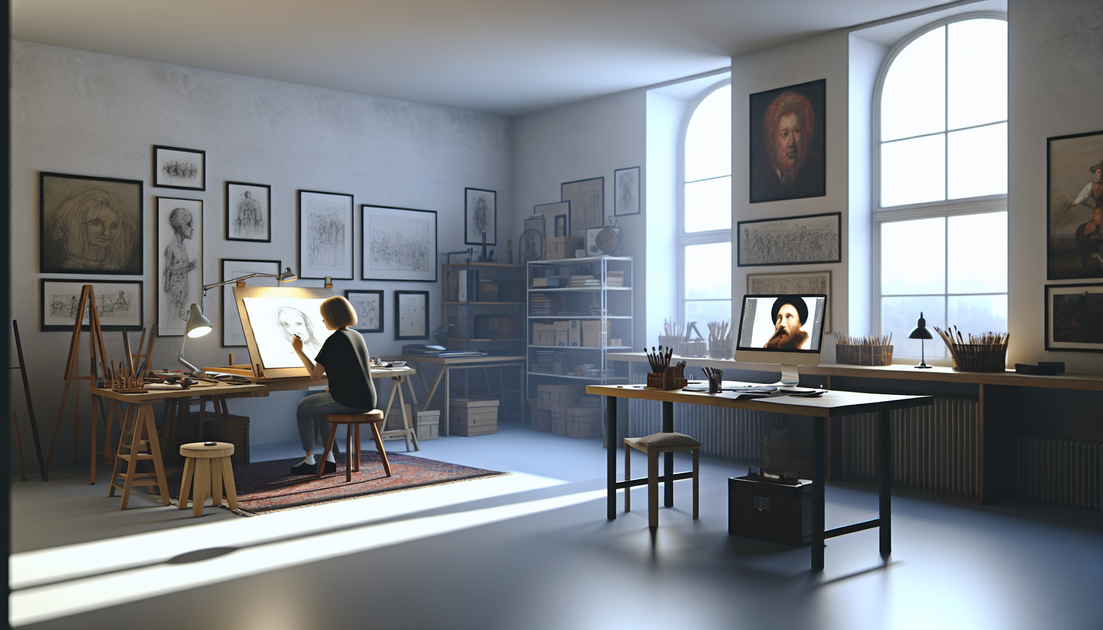
When billionaire investor Mark Cuban said that artificial intelligence would allow “creators to become exponentially more creative,” he probably expected applause. Instead, his comments sparked a sharp AI creativity debate across the internet—especially among the very people who build, teach, and use these tools daily. The question his statement raises is worth pausing on: does AI truly expand creativity, or does it risk flattening it into something less human?
Why did Cuban’s comment strike a nerve?
On its surface, Cuban’s message sounds optimistic. He sees AI as an amplifier—a way for artists, designers, and writers to multiply ideas quickly, test new directions, and push creative limits. That’s not an unreasonable take; plenty of creators have used AI tools like Midjourney or ChatGPT to prototype concepts that would’ve taken days by hand.
But the reaction online, particularly on Reddit’s r/artificial and among digital professionals, was mixed at best. Many creators pointed out that Cuban’s perspective overlooks the economic and emotional realities of creative work. When AI models can imitate illustration styles or generate music in seconds, the question isn’t only about creativity—it’s about credit, livelihood, and meaning. One designer wrote, “It’s easy to say AI expands creativity when your job isn’t the one being automated.”
I’ve seen this tension firsthand in creative tech circles. The excitement around new possibilities often sits right next to a quiet anxiety: if the machine can do it faster, what’s left for us to do?
How does AI actually change the creative process?
AI’s biggest promise is speed. It can brainstorm, generate mockups, and explore aesthetics at a pace no human can match. For a filmmaker or architect, that can mean more iterations and broader exploration before committing to a final concept. But speed isn’t synonymous with creativity. Creativity often thrives in constraint, in the slow problem-solving that happens between drafts or sketches.
In my own testing of generative tools, I noticed something subtle: AI can produce an endless stream of “good enough” results, but it rarely surprises me in the way a human collaborator might. Its creativity is wide but not deep—it recombines, it doesn’t originate. That doesn’t make it useless; it just means the human role changes. We become curators, editors, and translators of machine output.
That shift can be empowering or disorienting, depending on your expectations. A novelist might use AI to break writer’s block, while a concept artist might feel their unique visual language diluted by algorithmic mimicry. The same technology can feel liberating or threatening, depending on context.
What creators are actually doing with AI tools
The most interesting examples of AI in creative work often come from people who blend human intuition with machine efficiency rather than replacing one with the other. A music producer might feed their own vocal samples into a model to generate harmonies, then manually tweak the results. A game designer might use AI to populate background textures, freeing time for more complex level design.
Here’s one small story. A friend of mine, a freelance illustrator, started using an image-generation model to create rough compositions for clients. At first, she worried she was “cheating.” But over time, she realized the tool didn’t replace her—it just accelerated the boring parts. She still painted every piece by hand, but the AI sketches helped spark ideas she might not have reached alone. Her clients got faster turnarounds, and she felt less drained by the early stages of ideation. That’s the kind of middle ground many creators are quietly carving out.
Of course, not every story ends that way. Some illustrators have seen clients drop them altogether, opting for instant AI artwork instead. The technology’s accessibility means it democratizes creation while simultaneously destabilizing professional ecosystems. Cuban’s optimism doesn’t account for that complexity.
Why the AI creativity debate matters beyond art
This debate isn’t just about artists or writers—it’s about how society defines value in a world of automation. If AI can generate code, compose melodies, or design logos, what happens to the meaning of expertise? Do we celebrate efficiency, or do we protect the slower, imperfect processes that give work its human signature?
In education, for example, teachers now face students who use AI to generate essays or creative projects. Some see it as cheating; others see it as a new literacy. The same split appears in business: some executives treat AI as a cost-cutting tool, while others use it to augment human teams. The underlying question is the same—do we measure creativity by output, or by the process of getting there?
There’s also an ethical layer. Many generative models are trained on copyrighted or unlicensed material, raising concerns about fair use and compensation. Artists who find their work scraped into datasets may not feel “exponentially more creative”—they may feel exploited. Until those issues are addressed transparently, enthusiasm for “AI-boosted creativity” will always meet skepticism.
Can both optimism and caution be right?
Probably. AI doesn’t have to be purely good or bad for creativity—it can be a tool that reflects the values of whoever wields it. Mark Cuban’s perspective comes from an investor’s lens: innovation equals opportunity. But creators tend to see the immediate, ground-level impact. They live the tension between exploration and erosion.
One nuanced insight that often gets lost in these debates is that creativity itself isn’t static. Every major technological leap—from photography to digital editing—has redefined what it means to be creative. AI is just the latest, though perhaps the most unpredictable, of those leaps. The difference is scale: never before has a tool been able to mimic human output so convincingly, and so fast.
Still, I suspect the future will be more hybrid than either side fears. Humans will continue to find ways to imprint personality, emotion, and story into their work—traits that algorithms, for now, only approximate. The best outcomes might come from treating AI not as a rival but as a collaborator that needs clear boundaries and direction.
What this debate teaches us about creativity itself
If there’s a takeaway from the uproar around Cuban’s comment, it’s that creativity isn’t just about producing things—it’s about identity. For many, creative work is how they make sense of the world. When a machine steps into that space, the reaction is inevitably personal.
Maybe that’s why the AI creativity debate feels so charged. It forces us to ask what we value: the artifact or the act of making it. AI can multiply ideas, but it can’t yet replicate the emotional risk of starting from nothing. Whether it eventually learns to do so is an open question—and one that may not have a single answer.
For now, the healthiest stance might be curiosity tempered with caution. Use the tools, but stay aware of their blind spots. Let them accelerate you, not define you. And remember that creativity, even when mediated by machines, remains a deeply human endeavor.
Leave a Reply