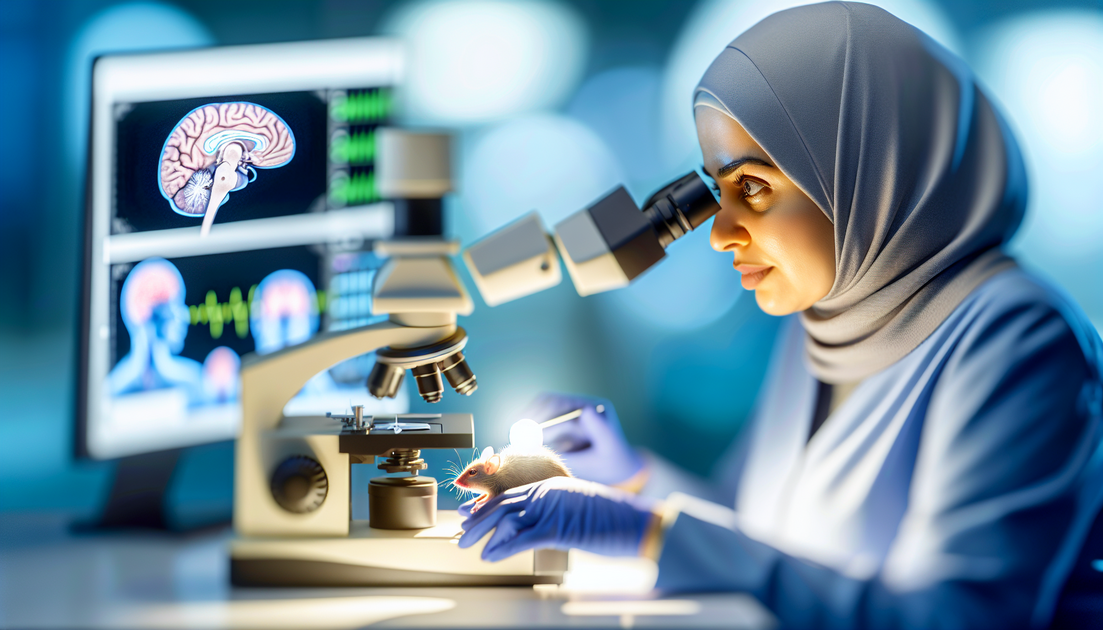
For decades, doctors told adults with lazy eye that their vision was fixed for life—that the brain’s visual wiring had long since hardened. Now, researchers might be rewriting that rule. In a recent mouse study, scientists demonstrated that rebooting vision in adults could be possible by briefly and reversibly anesthetizing the retina of the weaker eye. The result was striking: neurons in the brain began responding to that eye again, even after the usual “critical period” of visual development had closed.
Why This Discovery Matters
Amblyopia, often called lazy eye, affects roughly 2–3% of people. It usually develops in childhood when the brain favors one eye over the other, ignoring weaker visual input. Traditional treatment focuses on patching the stronger eye to force the brain to use the weaker one—but once someone reaches adulthood, the therapy usually stops working. The visual cortex, it was thought, becomes too rigid to rewire.
The new research challenges that assumption. By temporarily silencing the retina with anesthesia, scientists gave the visual system a kind of reset. When the eye “woke up,” the brain responded as if it were seeing it anew. That’s an extraordinary result, because it suggests that the adult brain still has dormant flexibility—it just needs the right conditions to tap into it.
When I first read about the experiment, I had to double-check the details. It sounded almost too clean: induce a reversible pause, wait a few days, then restore function. But the data, at least in mice, are convincing. The treated animals regained more balanced visual responses than the control group. It’s early-stage research, but the concept is refreshingly direct.
How the Retinal “Reboot” Works
To understand the mechanism, start with what anesthesia does. When scientists temporarily anesthetize the retina, they’re shutting down its electrical activity—essentially muting the visual signal before it reaches the brain. During that period, the brain’s visual circuits are deprived of input from that eye. Then, when the anesthesia wears off, the retina resumes normal signaling. The sudden return of input seems to trigger the brain to re-engage with that eye, as if recalibrating its sensory balance.
If you want to visualize it, think of a computer that’s been stuck favoring one monitor. You unplug the primary display for a moment, forcing the system to reconsider its configuration. When both screens come back online, the computer redistributes its attention. That’s roughly what’s happening in the visual cortex.
In practice, this “reboot” lasted only a few days in the experiment. The key was reversibility—long enough to interrupt old patterns, short enough to avoid damage. The retina recovered fully, and the brain adapted to the restored input. The simplicity of that sequence is what makes it so intriguing.
Lessons From the Lab
Here’s where things get interesting for anyone following vision science. The study doesn’t just suggest a new treatment idea—it also exposes a deeper truth about adult neuroplasticity. The adult brain, though less malleable than a child’s, is not static. It can change when conditions are carefully engineered.
In practical terms, that means future therapies might not need to rely on years of training or invasive surgery. Instead, they could use short, targeted interventions to “open the gate” for visual relearning. But the process will require precision. Too much silence, and the retina could suffer. Too little, and the brain may not reset. It’s a balancing act that must be tested safely in larger animals and, eventually, humans.
I’ve seen similar “reset” principles emerge in other fields. In machine learning, for instance, small perturbations—like briefly dropping out neurons in a model—can help a system escape local traps and find better solutions. Biology, it seems, may use a comparable trick.
When Hope Meets Reality
Before anyone imagines a quick fix for lazy eye, it’s worth emphasizing: this is still mouse data. Mice and humans share some visual processing features, but not all. Scaling a retinal anesthesia protocol to people introduces medical, ethical, and technical challenges. The retina is delicate, and safely anesthetizing it would require precise delivery methods.
Moreover, the experiment dealt with a controlled form of amblyopia. Real-world cases vary widely—some involve misaligned eyes (strabismus), others stem from unequal focus or early deprivation. Each case might respond differently. The timing, duration, and degree of anesthesia would likely need fine-tuning for individual patients.
Still, this work offers something rare: a concrete path forward in a field that’s long felt stuck. It’s a reminder that progress doesn’t always come from adding new layers of complexity. Sometimes, it comes from daring to pause the system and let it start again.
Seeing Through a Personal Lens
A friend of mine in college had amblyopia. She’d grown up wearing an eye patch for hours each day, but her depth perception never fully returned. I remember her frustration when new therapies would appear in headlines and then quietly fade. If something like this retinal reboot ever reaches clinical testing, she’d be among the first to volunteer. For people like her, even a modest improvement—say, sharper contrast or steadier focus—could change daily life in small but meaningful ways.
That’s the human side of this discovery. Behind the lab jargon and graphs, there’s a simple desire: to give adults a second chance at clear vision. And while no one should expect miracles, the possibility that the brain can be coaxed back into balance is worth pursuing.
What Comes Next
For now, the researchers plan to refine the method and probe the underlying circuitry. They want to know which neurons reactivate first, how long the effect lasts, and whether similar results occur with less invasive techniques—perhaps through temporary light modulation or targeted pharmacological agents. These details matter because they’ll determine whether this becomes a clinical tool or remains a scientific curiosity.
It’s easy to overlook incremental research like this, but I find it quietly revolutionary. Instead of assuming adult brains are fixed, scientists are learning where flexibility hides. That’s not just about vision—it’s a mindset that may ripple into other areas of neuroscience, from stroke recovery to chronic pain.
So if you’re reading this and thinking about what it means for your own eyesight, take it step by step. Don’t expect overnight treatments. But do pay attention: over the next decade, the idea that adult brains can’t change might finally fade out of focus.
Final Reflection
Science often advances not by giant leaps but by careful resets—turning off one system to see how it restarts. This study is a textbook example. By pausing the retina, scientists glimpsed a hidden reserve of adaptability in the adult brain. If future work confirms it, the way we understand sensory recovery could shift dramatically. And even if the approach never leaves the lab, it teaches a broader lesson: sometimes, to move forward, you need to stop, wait, and let the system reboot itself.
Leave a Reply