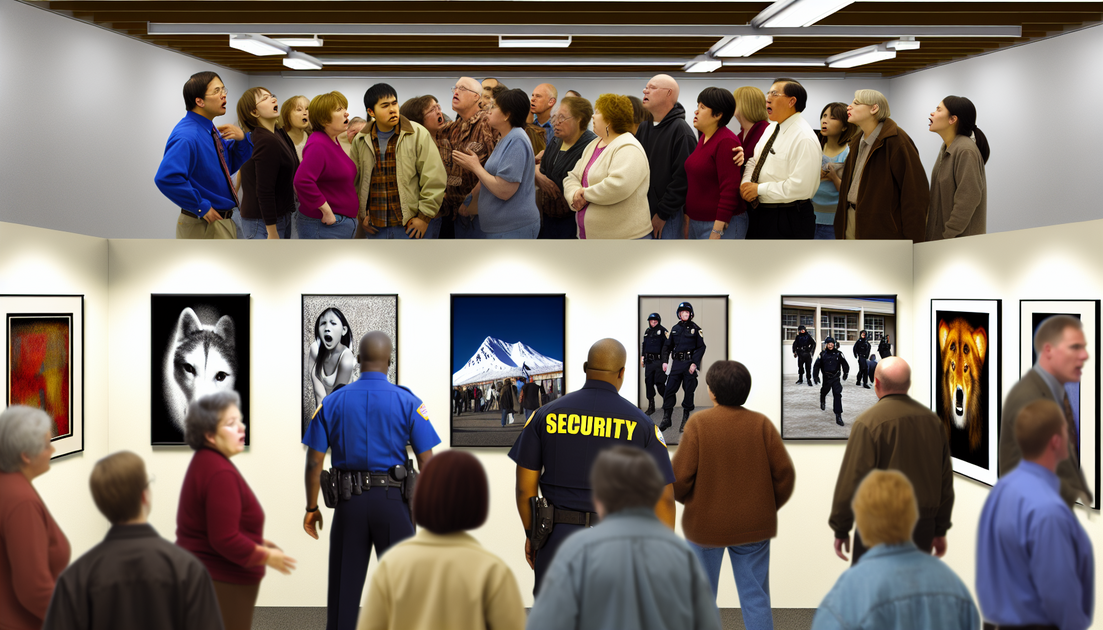
When news broke about an Alaska student AI art protest — in which a high school senior reportedly ate a piece of printed AI-generated artwork — the story spread quickly across social media. It was absurd, symbolic, and strangely fitting for our moment. But beyond the headline, it raises a deeper question: why is AI-generated art provoking such visceral responses, and what does this say about how we value creativity?
What actually happened in Alaska?
According to early reports circulating online, the incident took place at a student art exhibition in Anchorage. One of the displayed pieces had been created with the assistance of a generative image model — likely Midjourney or DALL·E. During the event, a student approached the piece, tore it from the wall, and dramatically chewed and swallowed part of it before being escorted away by staff and later arrested for disorderly conduct.
While some details remain unverified, the act itself — consuming a symbol of machine-made art — quickly turned into a meme and a point of debate. Was it performance art? A protest? Or simply a stunt? The truth may lie somewhere in between. Symbolically, it was a rejection of what the student saw as the “fake” or “soulless” nature of AI-generated imagery infiltrating human creative spaces.
Why does AI art provoke such strong emotions?
Generative art systems work by analyzing massive datasets of human-made images and learning the patterns that define composition, lighting, and style. They create new images statistically — not by intent, but by prediction. To many artists, that distinction matters deeply. The machine doesn’t “want” to make art; it just produces what looks like art.
In my own conversations with illustrators and designers, I’ve noticed a consistent tension. They admire the technical achievement of these models but feel uneasy about how easily the outputs imitate distinct human styles. For independent artists who struggle to make a living, this isn’t just philosophical; it’s economic. When AI-generated images can be produced in seconds, the market for human-made art shifts in unpredictable ways.
Emotionally, there’s also something unsettling about seeing creativity — one of the most personal human traits — replicated by statistics. It’s as if the boundary between expression and computation is eroding faster than we can process it.
How do generative models actually “create”?
At a technical level, systems like Midjourney or Stable Diffusion rely on large-scale neural networks trained on billions of images. These networks learn a probability space — a kind of mathematical map — of how visual features relate to textual descriptions. When a user enters a prompt, the system samples from that space, gradually refining random noise into a coherent image.
The mechanism is fascinating: the model doesn’t copy any single artwork but instead reconstructs an image that statistically fits the learned concept. It’s closer to remixing than reproduction. However, this process depends heavily on the dataset. If the dataset includes copyrighted works, then the model’s “style synthesis” can indirectly reproduce the essence of those works without explicit permission. That’s where the ethical and legal debates begin.
I’ve run a few small-scale experiments with open-source models, and the experience is both impressive and eerie. The system can generate something visually striking in seconds, yet it feels detached — like a mirror reflecting creativity rather than producing it.
What did the protest actually mean?
To interpret the Alaska protest, it helps to think of it as a form of symbolic communication. Eating the artwork wasn’t about destruction; it was about consumption — literally internalizing and rejecting the product of artificial creativity. It echoes older traditions of protest art, where shock and absurdity serve to highlight a moral or cultural boundary being crossed.
There’s a micro-story here that a local teacher reportedly shared: during a class debate about AI art earlier in the semester, the same student argued that “if machines start making art, then art stops being human.” Weeks later, that statement turned into action. The teacher described the moment as “part performance, part breakdown.” That duality captures something essential about our relationship with AI — fascination mixed with fear, admiration intertwined with resentment.
What are the legal and ethical dimensions?
From a legal perspective, the student’s arrest likely falls under standard property and disturbance laws, not anything specific to AI. But the broader questions linger. Who owns AI-generated art? If a machine produces an image based on learned patterns from human artists, is it derivative work or original creation?
Courts in the U.S. and Europe have begun addressing these issues, often ruling that AI-generated works without substantial human input are not eligible for copyright protection. Yet, determining what counts as “substantial” remains challenging. Is writing a detailed prompt enough? Or does authorship require iterative human curation and editing?
Ethically, the debate mirrors earlier shifts in art history. Photography once faced similar accusations of being mechanical rather than creative. But unlike cameras, generative AI doesn’t just capture reality — it fabricates new ones based on prior human labor. That makes the moral terrain more complex.
Could AI art and human art coexist productively?
Despite the tension, there’s reason to think coexistence is possible. Some artists already use AI tools as creative partners — starting with algorithmic sketches and then refining them by hand. In these cases, AI becomes a collaborator, not a replacement. The distinction lies in intention: when humans remain the authors, AI serves as a medium rather than a substitute.
I’ve seen musicians and visual artists integrate AI outputs into their workflow much as they once adopted digital editing or sampling. The key is transparency and consent: acknowledging the tool’s role and respecting the sources it learned from. Without that, the relationship between human and machine creativity risks becoming extractive rather than collaborative.
Education could also play a role here. Teaching students not just to use AI tools but to understand their mechanics might transform fear into fluency. The Alaska incident, dramatic as it was, underscores how urgently young creators need frameworks for thinking about authorship in the algorithmic era.
What does this episode tell us about the future of creativity?
In the short term, AI art will continue to challenge our definition of originality. In the long term, it might broaden it. If creativity is partly about combining ideas in new ways, then perhaps machines can participate — provided we remain clear about where the human element resides. The protest in Alaska, however extreme, reflects a genuine anxiety about losing that human center.
We’re still early in figuring out how to live with generative systems that mimic imagination. The student’s act was crude but unmistakably human — a reminder that even in a world of algorithms, protest, absurdity, and meaning-making remain ours alone.
Recap: what we learned from the Alaska protest
- AI-generated art operates through statistical learning, not genuine intent.
- Ethical concerns stem from the use of human-made data and the erosion of authorship boundaries.
- Protests like the Alaska incident reveal cultural unease, not just legal ambiguity.
- Human creativity may adapt by reframing AI as a tool rather than a threat.
In the end, the Alaska student’s act may seem foolish, but it captured something profound: our struggle to define what “making” means when machines can mimic it. Whether we reject or embrace AI art, the conversation it provokes is already reshaping how we think about creativity itself.
Leave a Reply