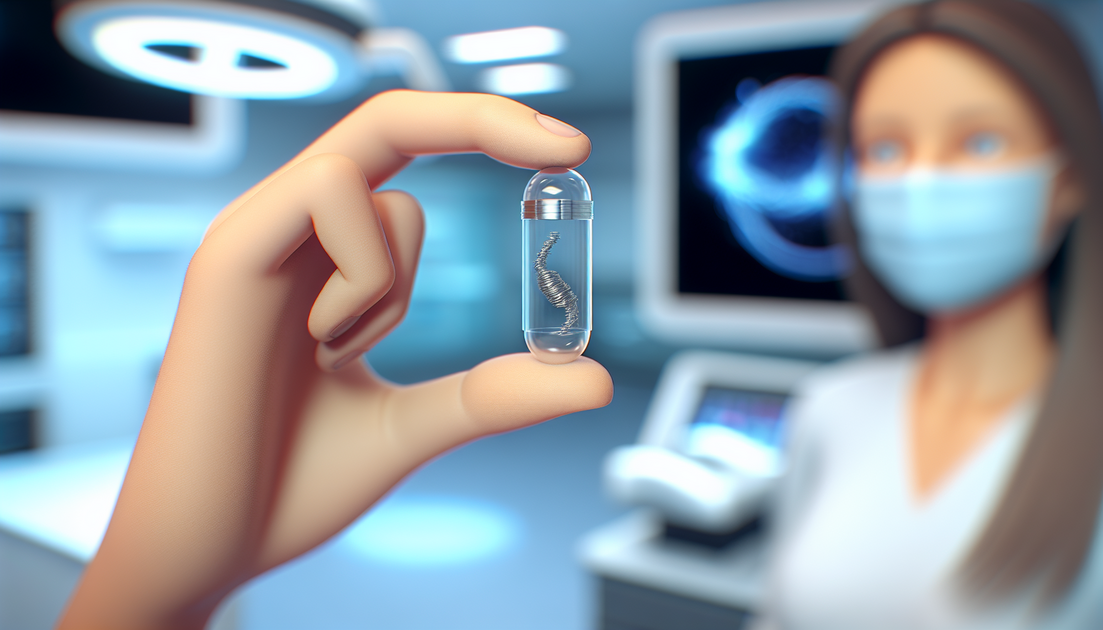
When I first read about biodegradable antenna pills from MIT, my immediate thought was how seamlessly they merge two worlds that rarely meet: wireless communication and human biology. The idea sounds futuristic — a tiny device that travels through the body, transmits data via radio frequency, and then simply dissolves. Yet, beneath that futuristic sheen lies a quietly methodical piece of engineering that could redefine how we monitor internal health.
1. The core mechanism behind the biodegradable antenna
At the heart of this technology is a radio frequency (RF) antenna made from biodegradable materials. Traditional antennas rely on metals like copper or silver, which obviously aren’t meant to stay inside a living body. MIT’s team, however, used materials that conduct electricity but can also safely break down after serving their purpose. Their design uses a combination of magnesium conductors and polymers that slowly degrade in bodily fluids.
The principle is straightforward: the pill’s antenna interacts with an external receiver, sending out RF signals that can be interpreted to measure parameters such as pH, temperature, or even specific biomarkers. Because the antenna is both flexible and dissolvable, it avoids many of the risks associated with permanent implants or external sensors.
2. Why this matters for internal health monitoring
Right now, internal monitoring usually relies on either invasive procedures or brief imaging snapshots. Doctors can insert catheters, use endoscopy, or rely on blood tests that offer indirect data. But these methods are episodic — they provide information at one point in time. A biodegradable antenna pill, by contrast, could offer continuous, wireless insight while passing naturally through the digestive system.
Imagine a patient with a chronic gastrointestinal condition. Instead of repeated hospital visits, they could swallow a capsule that quietly transmits data for a few hours or days. Once it dissolves, the device leaves no trace. In theory, this could allow earlier detection of internal bleeding, inflammation, or chemical imbalances that precede more serious issues.
3. A small story from the lab to the clinic
I once spoke with a gastroenterologist who described the frustration of diagnosing intermittent gut inflammation. “By the time we scope, it’s gone,” she said. Her patients experienced flare-ups that left little evidence by the time of examination. A sensor like this could change that dynamic. Instead of relying on symptoms alone, clinicians could capture data during real-time flare events — a kind of digital witness to a transient condition.
That story illustrates something easy to forget: technological progress in medicine isn’t just about new devices, but about closing information gaps that affect human lives in subtle ways.
4. The physics of radio inside the body
Wireless communication through tissue is not trivial. Radio waves behave differently in biological environments than in air; they attenuate quickly and scatter unpredictably. The MIT team’s design compensates by tuning the antenna’s shape and frequency to maximize signal penetration. In some prototypes, the pill operates at frequencies used by low-power medical telemetry, balancing range and safety.
From what I’ve read, the signal can be detected through several centimeters of tissue — enough for gastrointestinal or near-surface monitoring. However, the data bandwidth is modest. This isn’t a video stream; it’s small packets of physiological data. That’s perfectly adequate for many diagnostic purposes but may limit more complex sensing in the near term.
5. The materials challenge: dissolving on schedule
Designing something to dissolve safely inside a human body sounds simple until you consider timing. If it dissolves too quickly, it fails before transmitting all data. Too slowly, and it could linger longer than intended. MIT’s researchers control degradation rates by adjusting polymer composition, thickness, and environmental triggers such as pH or temperature.
In one test, the antenna maintained signal integrity for about two days before starting to lose conductivity. That’s enough for most short-term diagnostic windows. The magnesium core oxidizes and becomes harmless magnesium salts, while the polymer casing breaks down into molecules the body can process or excrete. It’s elegant — but controlling that process consistently across different patients and conditions will require further testing.
6. What still stands between research and real-world use
There are, of course, hurdles. Biodegradation must be predictable and uniform, which is difficult given variations in human physiology. Regulatory approval will depend on rigorous safety trials, not just proof that the antenna disappears. Power is another constraint: these devices either rely on tiny internal batteries (which must also be biocompatible) or harvest energy wirelessly, both of which add complexity.
There’s also the matter of data integrity. Wireless signals from inside the body can be noisy, and interference from other electronics — or even movement — could distort readings. Engineers are experimenting with algorithms that correct for these effects, but real-world reliability still needs validation.
In my view, this phase — bridging lab success to clinical robustness — is where most futuristic medical devices falter. The physics works, the prototypes function, but scaling to thousands of patients with predictable results is another story entirely.
7. Broader implications of biodegradable antenna pills
If these pills reach clinical maturity, the implications go far beyond the digestive tract. Similar designs could be used for temporary implants that monitor healing tissue, drug absorption, or infection markers. They could even provide short-term tracking for patients after surgery, reducing the need for external follow-up devices.
There’s also an environmental dimension. Conventional electronic sensors, even small medical ones, contribute to e-waste. A biodegradable electronic that naturally decomposes could represent a shift toward sustainable medical technology — a field that rarely intersects with environmental goals.
Still, one should temper the enthusiasm. While the idea of a self-dissolving, data-transmitting capsule is powerful, the path from prototype to prescription is long. Clinical trials will need to confirm not just safety but usefulness — that the information gathered truly changes outcomes. That’s a high bar, but one worth aiming for.
8. Where this research might lead next
Looking ahead, researchers are already exploring hybrid systems that combine biodegradable antennas with micro-sensors capable of measuring specific molecules. Others are testing bioresorbable batteries and transient circuits that could extend functionality without compromising safety. The eventual goal seems clear: temporary, intelligent electronics that integrate with the body only as long as needed.
It wouldn’t surprise me if, within a decade, swallowing a diagnostic pill becomes routine before major procedures or for chronic monitoring. But whether it’s MIT’s design or a derivative technology, success will depend on balancing precision, safety, and manufacturability. In medicine, elegance alone is never enough.
Conclusion: dissolving the line between machine and body
What the MIT team has shown isn’t just clever engineering — it’s a glimpse of a future where devices align more naturally with biology. The biodegradable antenna pill represents a subtle but profound shift: electronics that serve briefly, then vanish without trace. As someone who’s watched countless “next big things” in biomedical tech rise and fall, I find this one notable precisely because it’s modest in ambition yet potentially transformative in impact. It doesn’t aim to replace doctors or revolutionize care overnight. It just fills a gap — quietly, intelligently, and, eventually, invisibly.
Leave a Reply