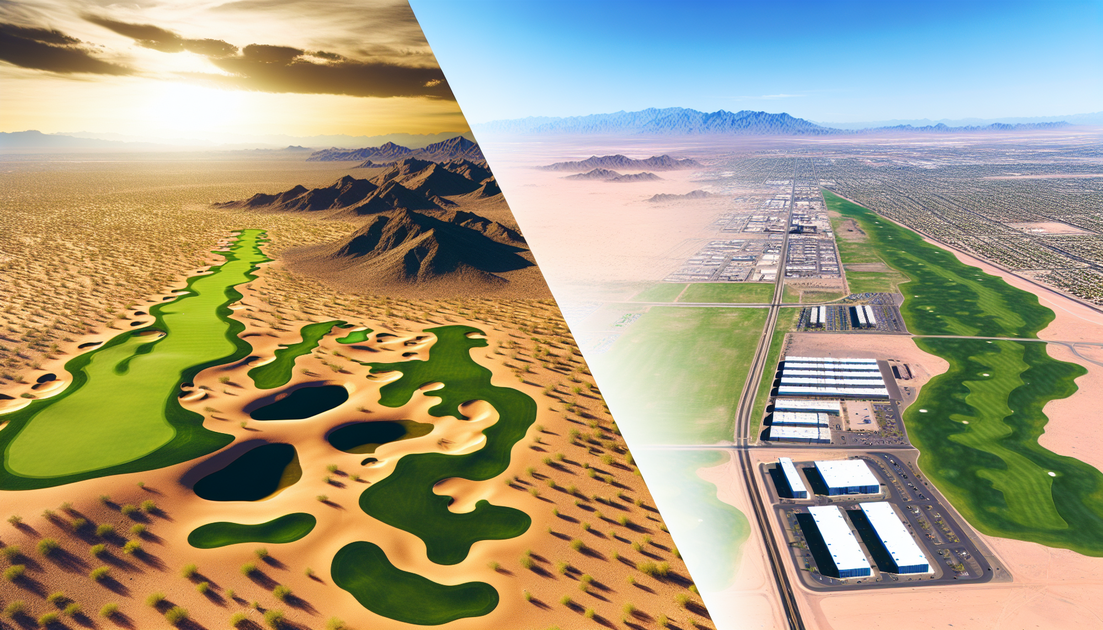
In Arizona, every drop of water tells a story about priorities. A recent comparison between golf courses and data centers in Arizona has sparked a quiet but meaningful debate: what kind of future do we want for the desert economy? Golf courses consume roughly 30 times more water than all of Arizona’s data centers combined, yet data centers generate about 50 times more tax revenue for every gallon they use. It’s a statistic that raises both eyebrows and questions about what sustainability really means in a state built on scarcity.
Why compare golf courses and data centers at all?
At first glance, golf and data have little in common. One is a pastime rooted in leisure and tradition; the other, an invisible backbone of the digital economy. But both rely on a single resource that defines life in the Southwest: water. Arizona’s identity has long been entwined with its golf resorts—green oases that promise escape from the desert’s austerity. Yet those same greens drink millions of gallons each year to stay lush under relentless sun.
Data centers, by contrast, look dry and utilitarian—large, windowless buildings quietly crunching numbers. They use water mainly for cooling servers, but modern designs have become remarkably efficient. Some centers operate on recycled water or closed-loop systems that drastically reduce consumption. When you zoom out, the comparison stops being about aesthetics and becomes about math: where can one gallon of water do the most good?
How much water are we really talking about?
Numbers make it plain. According to state water use data, golf courses in Arizona consume tens of billions of gallons annually. The state’s entire data center industry, by contrast, uses only a fraction of that—roughly one-thirtieth. Yet those data centers produce far more in economic output per drop. That 50-to-1 tax revenue ratio isn’t just trivia; it’s a measure of efficiency in a place where water is wealth.
Of course, not every gallon is equal. Golf courses also generate tourism dollars, jobs, and cultural value. They host tournaments, attract visitors, and offer a kind of community gathering space—albeit one accessible mostly to those who can afford it. The data center boom brings its own jobs, but fewer of them, and most are highly technical. So while the water math is easy, the social trade-off isn’t.
What would a future built on data look like?
It’s tempting to imagine a simple swap: convert fairways into server farms and call it progress. But the reality would be more complicated. Data centers demand reliable power grids, fiber connectivity, and land zoned for industrial use. Golf courses, often embedded in residential or resort areas, don’t always fit that bill. Yet some urban planners see potential in repurposing portions of recreational land for mixed-use developments that include digital infrastructure.
I’ve seen a similar debate play out in smaller cities that once relied on manufacturing. When industries shift, communities face tough choices: preserve identity or pursue sustainability. Arizona’s version of that tension plays out on a more elemental level—air, heat, and water. Each new data center represents both a technological leap and a cultural adjustment. It means fewer green lawns but perhaps a more resilient economy.
Micro-story: A tale from the edge of Phoenix
Last year, a friend who works in municipal planning told me about a retired couple living near Phoenix. They’d moved there decades ago for the golf lifestyle—sunrise tee times, evening cocktails at the clubhouse. But when their local course closed due to water restrictions, the land was purchased by a tech firm building a data center. The couple wasn’t thrilled at first. Yet as the project took shape, new businesses followed: a coffee shop, a small solar installer, a tech training center for local students. The couple still misses the green, but they admit the neighborhood feels “alive in a new way.”
Why not keep both—golf and data?
It’s a fair question. Arizona doesn’t need to abandon recreation to embrace technology. Some golf courses are already experimenting with hybrid models: smaller greens watered with reclaimed wastewater, native xeriscape landscaping around fairways, and even on-site solar arrays that power irrigation systems. Meanwhile, data centers are pursuing “waterless” cooling methods using air or advanced refrigerants. The challenge is to scale these innovations fast enough to keep up with growth and climate strain.
In my own observation, the debate often splits along generational lines. Older residents tend to see golf as a civic symbol, a way to make the desert hospitable. Younger professionals see it as wasteful symbolism—a relic of an era when abundance was assumed. Both perspectives hold truth. Water is emotional as much as it is physical. What we choose to water says something about what we value.
Could data centers become the new civic landmarks?
That might sound odd—few people dream of posing for family photos in front of a data center. Yet these facilities are quietly shaping the identity of modern cities. Just as railroads or factories once defined an era, digital infrastructure now defines ours. The question is whether that identity can coexist with environmental responsibility.
Some Arizona municipalities are already using tax incentives to attract data centers that meet strict water and energy efficiency standards. Others are tying permits to sustainability benchmarks. If done right, the state could model how technology and conservation align rather than collide. But if done poorly, unchecked expansion could deepen water inequality between regions or push smaller towns to their limits.
What does this debate reveal about us?
More than anything, this conversation about golf courses and data centers exposes the contradictions of modern life. We crave both the comfort of tradition and the promise of innovation. We want a thriving digital economy, but we also want green landscapes that soothe the eye. In a desert, those desires don’t always coexist easily.
Maybe the real question isn’t golf versus data, but growth versus adaptation. How do we evolve without erasing what people love about a place? The answer will differ from city to city, perhaps even from neighborhood to neighborhood. Still, the numbers are clear: Arizona’s water future will hinge on smarter choices, not just smaller lawns.
In summary: water, wealth, and values
The comparison between golf courses and data centers isn’t just about efficiency—it’s about identity. Data centers in Arizona show how the state can stretch scarce resources while maintaining economic vitality. Golf courses remind us that people need recreation and history, not just revenue. Balancing those truths will define the next chapter of desert life. And perhaps, as the old saying goes, it’s not about how much water we have—but what we choose to grow with it.
Leave a Reply