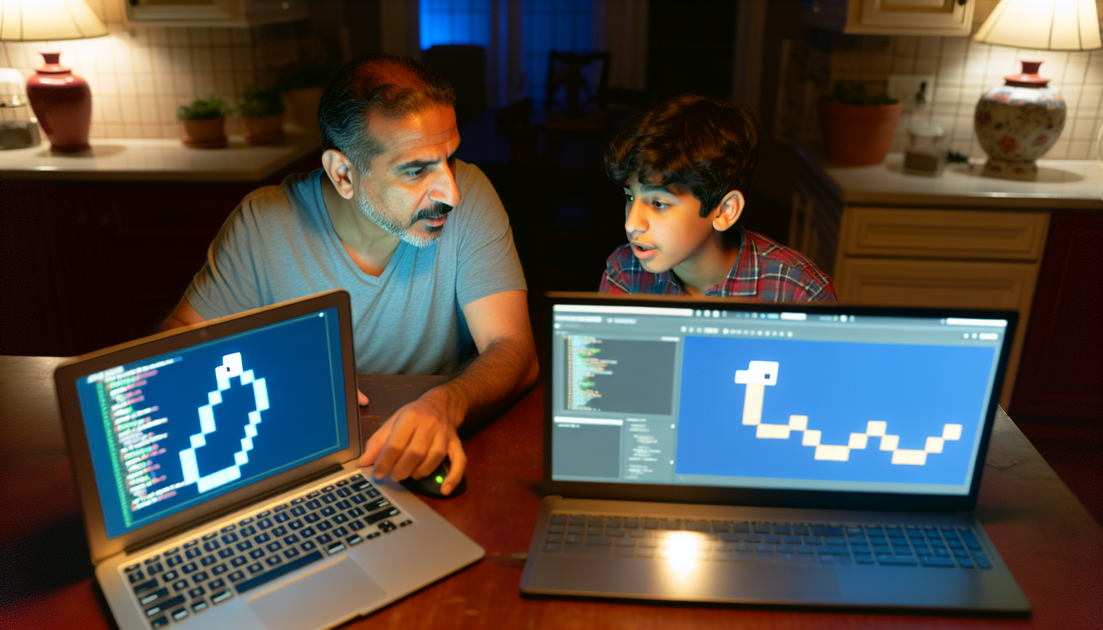
Late one evening, a father and his teenage son sat side by side at a kitchen table lit by the blue glow of two laptops. They weren’t debugging spreadsheets or doing homework—they were vibecoding, as the father put it, shaping their first playable prototype of a web game called SUPERSNAKES. With the help of Gemini 3 Pro and Google’s Antigravity environment, they were learning what building SUPERSNAKES with Gemini really meant: collaborating not just with each other, but with an AI that could suggest, refactor, and even inspire.
The quiet revolution of AI-assisted coding
What makes this story compelling isn’t just that a small team made a game in a few weeks. It’s that the boundaries of who—or what—counts as a “coder” are shifting. Tools like Gemini and Claude have turned what used to be solitary trial-and-error into a form of dialogue. You describe what you want, the model proposes code, you refine it, and soon you’re iterating faster than you could alone.
In this case, the father and son used Gemini 3 Pro to handle logic and visual tweaks in the browser-based game. Antigravity, Google’s experimental coding environment, allowed them to generate and test snippets instantly. The combination reduced friction: no setup nightmares, no dependency puzzles, just an open space to try ideas and see what stuck.
I’ve noticed a similar effect in my own experiments with AI pair-programming. It doesn’t replace the human sense of play or problem-solving—it amplifies it. You still have to ask the right questions, interpret the output, and bring style and intent. But the process feels less like typing alone in a dark room and more like sketching with a friend who always has a new suggestion.
From concept to code: what SUPERSNAKES adds to the genre
On the surface, SUPERSNAKES looks familiar. It’s a riff on the classic “snake.io” style: you grow longer by collecting pellets and try not to collide with others. But the small team behind it added twists that came directly from the creative flexibility AI tools allowed. Power-ups appear randomly, giving players speed boosts or temporary shields. Bombs litter the field, forcing quick reactions. Every minute, a boss snake spawns—something massive and aggressive—requiring players to find and use a gun power-up to defeat it.
That last feature, according to the developers, emerged accidentally. The father asked Gemini to “add a large snake enemy that attacks players periodically.” The AI produced a basic version with collision logic intact, but also suggested a scoring mechanic tied to defeating the boss. Instead of deleting that addition, they refined it, tested it, and realized it gave the game rhythm. The AI had proposed not just a feature, but a pacing mechanism.
This is one of the subtler benefits of AI-assisted creativity. Because the system doesn’t tire, it can generate many plausible directions quickly. Humans then act as curators—accepting, rejecting, or reshaping ideas. That interplay can lead to results neither side would reach alone.
Practical lessons from building SUPERSNAKES with Gemini
For anyone curious about experimenting with AI in coding, a few takeaways stand out from their process:
- Work conversationally, not mechanically. The father described their approach as “vibecoding”—a rhythm of prompting, testing, and adjusting. Instead of dictating precise instructions, they treated Gemini like a collaborator who could interpret intent.
- Keep your iterations small. AI models do best when they can see context clearly. By working in short loops—adding one feature, testing, then refining—they avoided the chaos that large code dumps can cause.
- Understand what the model knows. Gemini can suggest JavaScript logic or HTML layouts, but it doesn’t know your creative goals. You still need to define style, tone, and gameplay feel yourself.
- Use AI for scaffolding, not soul. The foundational mechanics can come from code generation, but the emotional “feel” of a game—the pacing, the art, the humor—still needs human hands.
That last point is worth emphasizing. AI can draft, but it cannot play. It can simulate feedback loops but not the tension of nearly losing to a boss snake or the satisfaction of a well-timed dodge. Humans provide the intuition that transforms code into experience.
Why collaboration feels different when AI joins the table
The micro-story of SUPERSNAKES also says something broader about how people learn and create together. Coding used to be a lonely art. Now, even beginners can lean on a model that offers explanations, syntax suggestions, and debugging help in real time. When paired with human curiosity, that can turn the learning curve from steep to playful.
There’s a moment in their story that captures this well. The father’s son reportedly laughed when Gemini’s code accidentally made the boss snake spawn inside another player, instantly destroying both. It was a bug, but also a moment of delight—a reminder that coding is still about discovery. Fixing that bug became part of the shared memory of making something together.
That human dimension matters. AI can accelerate production, but it can’t replace the meaning we attach to the process. In this case, the father wasn’t just teaching his son to code—he was teaching him to tinker, to experiment, to see mistakes as material. That’s the essence of creativity, whether your partner is a person or a model.
Looking ahead: what AI means for small creators
Projects like SUPERSNAKES hint at a quiet democratization of development. Ten years ago, a two-person team would have needed months to build a web game with upgrades, boss logic, and multiplayer elements. Today, with tools like Gemini, that timeline can shrink to weeks. But it’s not just about speed. It’s about accessibility. The barriers to entry—complex frameworks, missing documentation, and endless setup—are beginning to erode.
Still, uncertainty remains. AI models aren’t perfect, and they can introduce subtle bugs or security issues. Relying too heavily on them risks losing track of how your code actually works. I’ve seen small teams struggle when updates to the model changed its coding style mid-project. So while these systems can empower, they also demand vigilance and a willingness to understand what you’re building beneath the surface.
Perhaps the most surprising insight in all this is that AI doesn’t flatten creativity—it multiplies it, but only when guided carefully. The best results often come from constraint: giving the model a narrow prompt and then interpreting its output through your own aesthetic lens. In other words, the more human you remain in the loop, the more interesting the results become.
One takeaway worth remembering
SUPERSNAKES isn’t just another .io game. It’s a small proof of concept for a future where making things—games, tools, art—feels more conversational and less technical. Where “coding” might involve as much dialogue as syntax. And where building with AI is less about automation and more about amplification.
As the father and son behind the project discovered, the real reward isn’t just finishing a game; it’s realizing that collaboration can happen in new ways. The line between imagination and implementation is thinner than it’s ever been—and it’s moving closer to our fingertips.
Takeaway: When humans and AI build together, the code becomes a conversation—and creativity becomes a shared language.
Leave a Reply