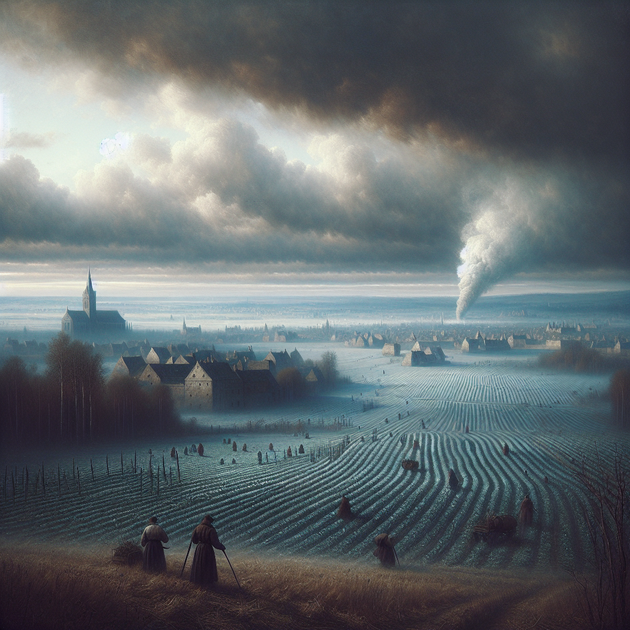
For centuries, historians have blamed trade routes and infected fleas for spreading the bubonic plague across medieval Europe. But what if a volcanic eruption Black Death connection played a deeper role—setting off environmental changes that made the continent ripe for catastrophe? Recent interdisciplinary research suggests this may be exactly what happened.
By linking ice-core data with historical records, scientists are uncovering evidence that a massive volcanic event preceded one of humanity’s most devastating pandemics. The idea is both startling and strangely logical: when Earth’s atmosphere turns opaque with ash and sulfur, harvests fail, populations weaken, and disease spreads more easily. Yet turning this hypothesis into evidence has taken decades of sleuthing through layers of ice and sediment.
What evidence connects a volcano to the 14th-century plague?
Ice cores drilled from Greenland and Antarctica record Earth’s atmospheric history like an ancient ledger. Within those layers lie traces of sulfuric acid—a signature left behind by major eruptions. Around the early 1340s, scientists found an unusually strong sulfate spike indicating a colossal eruption somewhere in the tropics or high latitudes.
Radiometric dating aligns this event just before 1347–1348, when reports of pestilence began sweeping from Central Asia toward Europe. Researchers studying tree rings also noticed signs of sudden cooling during that period—a “volcanic winter.” Crops failed in several regions; famine followed in parts of Eurasia. Although correlation does not prove causation, these converging lines of evidence suggest a severe environmental shock immediately before the Black Death’s outbreak.
The culprit volcano has not been definitively identified. Some geologists suspect an eruption in Indonesia or possibly Alaska; others propose Icelandic sources given its record of violent activity. Until geochemical fingerprints from ash layers are fully matched to known volcanoes, that detail remains uncertain.
How could an eruption influence pandemic dynamics?
The pathway from ash cloud to epidemic is indirect but plausible. Volcanic aerosols reflect sunlight back into space, leading to cooler temperatures and altered rainfall patterns for one to three years after a major eruption. Cooler summers shorten growing seasons; wetter conditions can expand rodent habitats—the natural reservoirs for Yersinia pestis, the plague bacterium.
When food stores run low and wildlife patterns shift, humans and rodents interact more frequently around settlements. In my own reading of medieval chronicles, it’s striking how often accounts of “great hunger” precede descriptions of illness. Malnutrition weakens immune systems; social unrest drives migration; trade intensifies as communities seek scarce grain. Each factor magnifies disease transmission.
This chain reaction—environmental stress feeding biological vulnerability—is not unique to the 14th century. Modern epidemiologists see similar patterns today when droughts or floods alter vector populations. What makes the medieval case so haunting is its scale: one natural disturbance may have nudged an entire continent toward collapse.
A small story from a cold year
In one chronicle from northern France, a monk described “a summer without warmth” when barley grew thin and green even by harvest time. He noted villagers grinding acorns into meal and trading firewood for bread at ruinous prices. A few months later came rumors of sickness arriving from Genoese ships in Marseille. The monk never made any connection between these events—but reading his words now feels almost prophetic.
I’ve always found such first-hand glimpses grounding amid scientific reconstructions. They remind us that behind every climate marker or microbial lineage were real people—farmers staring at failing crops under gray skies—unaware that nature had already tipped their world off balance.
Why has this link taken so long to confirm?
Partly because both sides of the equation—the eruption and the pandemic—are complex systems with many unknowns. Ice-core analysis can pinpoint sulfate spikes but rarely identify exact volcanoes without accompanying tephra (ash particles). Historical climate proxies like tree rings give relative temperature trends but not absolute causes. Meanwhile, genetic studies of Yersinia pestis trace multiple introductions across centuries rather than one continuous outbreak.
Only recently have researchers combined all these datasets using improved radiocarbon calibration and Bayesian modeling techniques. Cross-disciplinary collaboration between climatologists and historians has also grown stronger. It’s one thing to find a chemical signal; it’s another to interpret how that signal rippled through medieval societies already stressed by war and economic inequality.
Even with modern tools, uncertainty persists. Some scholars argue that regional famines or trade disruptions could explain timing coincidences without invoking volcanism at all. Others question whether aerosol loading from one eruption could sustain multi-year cooling sufficient to reshape epidemiological patterns on such a large scale.
What broader lessons emerge from this theory?
If confirmed, this connection reframes pandemics not as isolated biological accidents but as outcomes intertwined with planetary processes. It suggests humanity’s vulnerability often begins long before pathogens arrive—rooted in how ecosystems respond to abrupt climatic shocks.
The insight also highlights feedback loops between nature and society:
- Environmental trigger: An eruption injects sulfur aerosols into the stratosphere.
- Climatic response: Global temperatures dip; rainfall shifts unpredictably.
- Agricultural impact: Harvest failures cause hunger and displacement.
- Epidemiological cascade: Weakened populations face heightened disease exposure.
This pattern echoes across history—from volcanic winters preceding Roman crises to cooling episodes after Krakatoa in 1883 that disrupted harvests worldwide. What’s new is our ability to detect these ancient signatures precisely enough to map cause-and-effect chains stretching over decades.
I’ve seen readers react skeptically to such deep-time connections—it can feel speculative or even deterministic—but recognizing these links doesn’t erase human agency. It just expands our understanding of context: how fragile equilibrium can be when planetary systems shift suddenly.
The continuing mystery of timing
The timing still puzzles researchers. The sulfate peak appears slightly earlier than some plague chronologies suggest—perhaps by three to five years depending on calibration models. That gap could reflect delays in social consequences rather than measurement error: famine conditions can take several seasons to intensify before disease outbreaks reach critical mass.
An additional complication is spatial variation. Not all regions suffered equally from cooling; southern Europe experienced milder effects than northern zones. Yet ports like Genoa became infection gateways regardless of local weather because maritime trade carried both goods and fleas across temperature gradients.
This unevenness hints that environmental disruption set broad conditions while human networks determined specific outcomes—a nuanced interplay rather than a single trigger point.
A final look back—and forward
The idea that an unseen volcano half a world away might have helped ignite Europe’s worst pandemic is humbling. It reminds us how deeply connected geological events are to biological destinies. A pulse of magma beneath Earth’s crust can change atmospheric chemistry; altered skies can reshape societies hundreds of miles away.
The story isn’t finished yet. Ongoing fieldwork continues to hunt for matching ash deposits that could confirm which volcano erupted around 1340 CE. DNA sequencing from archaeological gravesites might refine timelines further, clarifying whether environmental stress preceded each wave or merely coincided with them.
For now, we can say this much with confidence: something extraordinary happened in Earth’s atmosphere right before humanity faced one of its darkest trials—and understanding that sequence could reshape how we read history itself.
Key takeaways
- A major volcanic event likely occurred shortly before the mid-14th-century pandemic began.
- Cooling and crop failure may have created conditions favoring plague spread through weakened populations and altered ecosystems.
- The exact volcano remains unidentified; researchers continue analyzing ice-core chemistry for definitive matches.
- This work underscores how environmental shocks can cascade into societal crises—a lesson still relevant in today’s changing climate.
The potential link between fire from below and death above ground bridges geology and history in unsettling ways—but also offers clarity about our shared fragility on this restless planet.
Leave a Reply